Early-Stage Legal Analysis for Smarter Land Development Decisions
Before land is acquired, rezoned, or developed, the most important work often happens behind the scenes. Zoning classifications, comprehensive plans, overlay districts, environmental constraints, infrastructure capacity, and political considerations can significantly affect a project’s viability.
Bean, Kinney & Korman advises developers, property owners, investors, and institutional clients throughout Maryland, Virginia, and the Washington, D.C. region on land use feasibility and strategic planning. We help clients evaluate regulatory risk, entitlement pathways, and approval probability before significant capital is committed.
Our goal is to provide clear legal insight that supports informed investment decisions and reduces the risk of costly delays or project denial.
Feasibility & Strategic Planning Services
Zoning & Land Use Analysis
- Review of current zoning classifications
- Evaluation of permitted and conditional uses
- Overlay district and special area analysis
- Density and height limitation review
- Setback, parking, and open space requirements
Understanding baseline zoning constraints is the first step toward sound planning.
Comprehensive Plan & Policy Review
- Alignment with local comprehensive plans
- Growth policy and future land use designation analysis
- Transit-oriented development considerations
- Community planning overlays and master plans
Strategic alignment with policy frameworks strengthens entitlement prospects.
Entitlement Pathway Assessment
- Rezoning feasibility analysis
- Special use and conditional use potential
- Variance standards evaluation
- Planned unit development (PUD) opportunities
We evaluate the most efficient legal path to achieve project goals.
Regulatory & Environmental Constraints
- Environmental overlay analysis
- Historic preservation considerations
- Stormwater and infrastructure limitations
- Utility capacity and impact assessment
Early identification of technical constraints reduces later project disruption.
Political & Community Landscape Assessment
- Public hearing process overview
- Stakeholder engagement strategy
- Anticipation of community concerns
- Evaluation of likelihood of opposition
Understanding the political landscape is often as important as understanding the zoning code.
Risk & Financial Impact Evaluation
- Regulatory risk assessment
- Entitlement timeline forecasting
- Financing sensitivity to approval risk
- Scenario planning for alternate development strategies
We help clients align legal feasibility with financial modeling and capital planning.
Who We Represent
Our Feasibility & Strategic Planning practice serves:
- Real estate developers
- Commercial property investors
- Mixed-use and multi-family sponsors
- Institutional landholders
- Franchise and retail developers
- Healthcare and institutional project sponsors
- Infrastructure and public-private project participants
- Government contractors requiring site approvals
We tailor feasibility analysis to the scale and financial objectives of each project.
Industries Served
We regularly advise clients in sectors including:
- Commercial and office development
- Retail and hospitality projects
- Industrial and logistics facilities
- Mixed-use and urban redevelopment
- Multi-family and residential development
- Healthcare campuses
- Public infrastructure projects
- Transit-oriented development (TOD)
Industry awareness informs regulatory and political strategy.
Feasibility & Strategic Planning FAQs
What is land use feasibility analysis?
Land use feasibility analysis evaluates whether a proposed development aligns with current zoning regulations, comprehensive plans, and regulatory requirements, and assesses the likelihood of obtaining necessary approvals.
Should legal counsel be involved before purchasing property?
Yes. Early legal review can identify zoning constraints, entitlement risks, overlay restrictions, and regulatory barriers that may materially affect property value or development potential.
What is a comprehensive plan?
A comprehensive plan is a municipality’s long-term planning document outlining land use policy, growth strategy, transportation planning, and development goals. Alignment with the comprehensive plan often influences entitlement decisions.
How long does the entitlement process typically take?
Timelines vary based on project scope, required approvals, jurisdiction, and potential opposition. Early feasibility planning helps establish realistic timelines and manage investor expectations.
What happens if zoning does not permit the intended use?
If the proposed use is not permitted by-right, alternatives may include rezoning, obtaining a special use permit, seeking a variance, or adjusting the development plan to fit existing zoning standards.

Videos
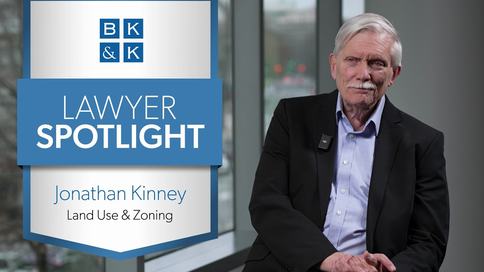




Recent Highlights
Blog Post

What Is Worrying Our Nonprofit Clients – Part V: Political Risk and the Nonprofit Mission
Event
On Board: Elevating Nonprofit Board Leaders, presented by Leadership Center of Arlington
Video
The BKK Beat, Episode 32: IP Law in the News - Fender's Stratocaster, Part 5
News / Publication
23 Attorneys from Bean, Kinney & Korman Recognized as Top Attorneys for 2026 by Arlington Magazine
Blog Post

When Can Nonprofit Employees Volunteer for Their Employer?
Event

What the New Non-Compete Rules Mean for Virginia Employers
Video
The BKK Beat, Episode 31: IP Law in the News - Fender's Stratocaster, Part 4
News / Publication