Intellectual Property
Fair Use Protections Unlikely with AI-Generated Content: What Marketing Teams Get Wrong About AI
November 16, 2026
In June 2025, two federal judges in California held within two days of each other that training an artificial intelligence (AI) model on copyrighted books can be sufficiently transformative to qualify as fair use. The decisions attracted widespread coverage and could leave marketing teams with a misleading takeaway that the courts have blessed generative AI usage in commercial contexts.
That is the wrong lesson. A ruling about model training does not resolve whether the content of your next campaign featuring generative-AI assets infringes on someone else’s rights.
The two California decisions addressed solely whether the companies that build AI models could copy books to train them, and did not look at any particular output provided by such models. To be clear: fair use was a defense solely for the model developer, and solely with regard to the act of training. If you are the business running an advertising or marketing campaign using AI-generated content, those decisions do not protect you. Both judges stated plainly that the people who publish AI-output remain responsible for what is in it.
Fair use can be difficult to establish when you use someone else’s protected work simply to attract attention to your product or replace content you would otherwise license. Other domains, including art (parody or criticism), news reporting (showing short excerpts to report on a public interest story) or teaching/scholarship (citing passages or including a video clip to teach a lesson) can more successfully avail themselves of the protections of the fair use doctrine. However, advertising and marketing are seen as having less of a prosocial and necessary justification for using a third party’s protected work, so the fair use doctrine’s protections are less likely to extent to such uses.
What the Courts Actually Decided
Two rulings from the Northern District of California, both from June 2025, illustrate the distinction between training a model and publishing its output.
In Bartz v. Anthropic PBC, 787 F. Supp. 3d 1007 (N.D. Cal. 2025), Judge William Alsup found that using books to train a model was "quintessentially transformative" and therefore fell under fair use. He noted that training a model converts text into statistical relationships rather than storing the original expression for third party readers. Judge Alsup drew a hard line elsewhere: keeping a library of pirated copies was not excused by the training purpose and was not covered by fair use. It is notable that, in Bartz, the judge noted that “[a]uthors do not allege, however, that any LLM outputs infringing upon their works ever reached users of the public-facing Claude service.”
The Claude service also put in place additional software that ensured that no infringing output ever reached users (e.g. software prevented the reprinting of large pieces of protected and unaltered text). The judge continued: “And, if the outputs were ever to become infringing, Authors could bring such a case [against Anthropic].”
Regardless of the training activity being protected as ‘fair use’, the other activities were not found to be protected. As such, Anthropic settled with the plaintiff class for $1.5 billion for the use of roughly 482,000 works.
Two days later, in Kadrey v. Meta Platforms, Inc., 788 F. Supp. 3d 1026 (N.D. Cal. 2025), Judge Vince Chhabria also found fair use, and extended it to materials obtained from “shadow libraries” (libraries of knowingly pirated content). However, in so doing he chided Judge Alsup in Bartz for ignoring that, under the fair use doctrine, harm to the market for the copyrighted work is more important than the purpose for which the copies are made. He also noted the plaintiffs had failed to adequately support the argument that would have prevailed in the case – that unauthorized use in training and output would dilute the marketplace for these authors’ books. However, in finding that fair use applied based on the presented record, he noted that:
in many circumstances it will be illegal to copy copyright-protected works to train generative AI models without permission. Which means that the companies, to avoid liability for copyright infringement, will generally need to pay copyright holders for the right to use their materials. . . This ruling does not stand for the proposition that Meta's use of copyrighted materials to train its language models is lawful. It stands only for the proposition that these plaintiffs made the wrong arguments and failed to develop a record in support of the right one.
These decisions resolved particular disputes and do not create binding precedent, even within their own jurisdictions. They certainly do not give clearance for a marketer or advertiser to use generative AI without consequence. You should not treat that result as blanket permission to train on copyrighted works or publish infringing output.
Why Fair Use is Difficult to Claim in an Advertising Context
Fair use is a legal doctrine that permits certain unlicensed uses of copyrighted works in certain contexts. It acts as an exception and an affirmative defense against copyright infringement lawsuits, balancing exclusive rights of creators with the public interest in free speech, education, and creativity. Evaluating whether or not fair use can be properly invoked requires a four-factor analysis described pursuant to 17 U.S.C. § 107, weighed case by case, which include: (1) the purpose and character of the use; (2) the nature of the copyrighted work; (3) the amount and substantiality of the excerpt relative to the whole work; and (4) the effect on the potential market for or value of the work. No factor automatically defeats an advertising use; however two of those factors run against advertising almost automatically.
The first factor asks about the purpose and character of the use, including whether it is commercial. If you use protected content to promote sales of a product or service, that purpose is ordinarily commercial. In Andy Warhol Foundation for the Visual Arts, Inc. v. Goldsmith, 598 U.S. 508 (2023) the Supreme Court held that, where a later use shares substantially the same purpose as the original use and the later use is commercial, the first factor weighs against fair use. A different visual style or message alone did not establish fair use where the use (illustrating a magazine article about Prince) is not transformative. Marketing material rarely comments on the work it borrows in a sufficiently transformative manner to satisfy this prong of the test.
The fourth factor asks about the effect on the market for the original. If a photographer licenses images to businesses, and an advertising or marketing firm uses one of those images without paying the artist, they have displaced a sale of a license that would ordinarily go to the photographer. Such displacement clearly harms the market.
For a fuller explanation of how the factors apply, see our earlier article on fair use.
Marketers often reflexively jump to two intuitive responses, neither of which are, on their own, actual defenses: "we only used a small piece" and “we credited the source”. The former does not help much, because the third factor looks at substantiality as well as amount, and even a short recognizable fragment can constitute the “heart” of a work, and there is no universally safe word count or percentage. "We credited the source" does not protect against an infringement claim in most cases, either; attribution is good practice, but it doesn’t grant a license to use someone else’s work and it is not a fair use defense.
When a marketing team asks whether fair use covers putting copyrighted material in a campaign, the honest answer is almost always no. The emergence of generative AI did not change the test used to analyze fair use or reasonably improve one’s chances of succeeding in using it as a defense.
Risk One: Output that Resembles Protected Content
Liability can arise if your generative AI output copies protected expression or creates a likelihood of confusion about source, sponsorship, or endorsement. Generative models occasionally produce output that closely resembles specific protected work, character, logo, or trade dress. However, merely because misuse is inadvertent or accidental does not change the tests used to evaluate copyright or trademark infringement, though it may affect available remedies. If you publish infringing content, the fact that a machine produced it or that you did not intend to infringe does not ordinarily excuse the infringement.
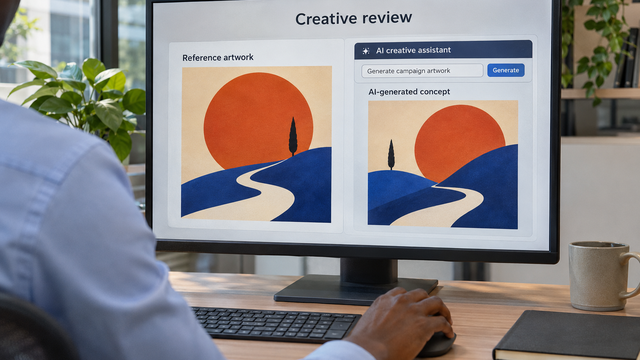
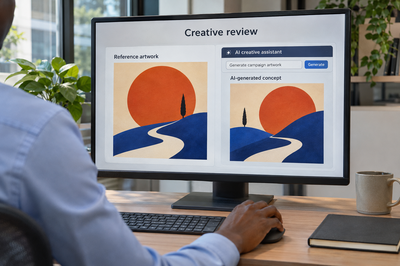
Generative AI prompts are a common source of trouble in establishing a fair use defense. Asking for an image "in the style of" a named living artist or uploading a competitor's protected artwork as a reference raises the odds of an output that borrows more than style, and can be used to show intent to infringe. Additionally, uploading a rightsholder’s artwork to guide the output also requires review of the rights to copy, upload, and use that reference.
The most effective methods for avoiding infringement are intuitive and unglamorous, and include restricting prompts targeting specific artists or brands unless approved, using reference material only when authorized or otherwise legally justified, and having a human review the final asset for protected elements and misleading associations. A reverse image search can help identify problems, but a clean result is not legal clearance.
Risk Two: Your Tool's Terms of Service
Another common unforced error by marketing and advertising teams is presuming that they have permission from the creator of an AI tool to use generative AI outputs for all commercial purposes.
AI tools vary enormously in what rights they permit you in their output. Free and consumer-tier generative AI tools frequently restrict or prohibit commercial use of their outputs. Some permit limited commercial uses but explicitly carve out advertising, or may condition such use on an ongoing subscription to the tool that your company may or may not have. Some offer indemnification for third-party claims, and some expressly disclaim it. Violating applicable contractual rules can result in a contract claim against a marketer or advertiser even where no third party artist’s artwork has been reproduced.
You cannot determine the applicable contractual rights by looking at the output. A marketing coordinator generating images on a personal free account for a campaign for their employer has created a contract problem that no fair use analysis will fix. As such, before a generative AI tool is used for client-facing work, the terms and conditions of its use should be reviewed to ensure that (1) you may use the output commercially in the intended campaign; (2) you have sufficient contractual rights to use, modify, and provide the output to your company or client, recognizing that a contract cannot create copyright in otherwise unprotectable material; and (3) you understand whether any indemnification is available and the conditions, exclusions, and limits that apply.
Risk Three: Likeness, and Why the DMV Makes This Harder
If a campaign depicts or imitates an identifiable real person, rights of publicity and privacy may apply alongside copyright and trademark law. These rights are typically governed by state law, making coordinated marketing campaigns in the Washington Metropolitan Area, which covers multiple jurisdictions, difficult.
Virginia Code § 8.01-40 creates a civil claim for the unauthorized use of a person's name, portrait, voice, likeness or picture for advertising or trade, with injunctive relief and damages available in the event of misappropriation. Virginia courts have held that punitive damages under the statute do not require proof of willful or malicious conduct, which makes it more dangerous than its length suggests. Legislation addressing digital replicas has been introduced, so the statute is worth rechecking before relying on its current scope.
Maryland has no general right of publicity statute. Claims commonly proceed under the state’s common law appropriation tort, which Maryland courts have limited to situations where the name or likeness has commercial value and the use is not incidental.
The District of Columbia likewise generally addresses these claims through common-law misappropriation rather than a separate statutory right of publicity. The analysis considers the value associated with the person’s identity and recognizes limitations for incidental use and protected expression.
If you create a fictional AI spokesperson or voice reading, a single use can therefore produce three different analyses depending on where a claim is brought. Synthetic influencers, AI-generated customer photos, and voice cloning all generally use composites from real people and sources, so the best course of action is to receive consent from custom-selected individuals where possible.
Risk Four: Misleading Advertising
Disclosure does not cure deception. Labeling an image as AI-generated does not help if the image overstates what your product does.
The Federal Trade Commission's Rule on the Use of Consumer Reviews and Testimonials, 16 C.F.R. Part 465, effective October 21, 2024, is directly relevant. It prohibits fake or false consumer and celebrity testimonials, and it expressly reaches AI-generated reviews and testimonials from people with no actual experience with the product. It carries civil penalties per violation, adjusted annually for inflation.
A fabricated customer experience, false endorsement, or generated before-and-after image showing unsupported results can also violate the FTC Act. Virginia’s Consumer Protection Act, Maryland’s Consumer Protection Act, and D.C.’s Consumer Protection Procedures Act each provide additional rules against misleading consumer advertising, subject to their respective scope and exemptions. Health, finance, and professional-services advertising may face further sector-specific requirements that should be complied with in all advertising and marketing efforts.
A Note on Logos
Logos are primarily governed by two different bodies of law, and people routinely conflate them.
A purely AI-generated logo lacks copyright protection if it contains no protectable human authorship. Trademark rights work differently. A distinctive logo can acquire rights through qualifying use as a source identifier and may be eligible for registration even if AI produced it. Authorship is not the trademark test; distinctiveness, use, and other registration requirements still apply.
You may hold trademark rights in the mark while having no copyright in the artwork, which limits your options against someone who copies the design without competing with you. If the generative AI tool produced something materially similar to an existing mark, inadvertent infringement can occur. Clearance searching (performing a systematic review of existing trademarks, brand names, logos, slogans, and marketplace uses to determine whether a proposed mark is available to use and register without infringing on someone else’s rights) is essential.
Who Owns Your Output?
Suppose your company analyzes all four risks listed above and concludes that a generative-AI-created output will not infringe others’ rights. You should still ask: what rights to do you actually have in the output, and can you enforce those rights against others?
On March 2, 2026, the Supreme Court declined to hear Thaler v. Perlmutter, 687 F. Supp. 3d 140 (D.D.C. 2023), aff’d, 130 F.4th 1039 (D.C. Cir. 2025), leaving in place the D.C. Circuit's holding that the Copyright Act requires a human author for material to be protected. The Copyright Office reached a similar conclusion in Copyright and Artificial Intelligence, Part 2: Copyrightability, released January 29, 2025, which holds that AI output is protectable only where a human contributes sufficient expressive material, and that prompting alone is not sufficient to satisfy this requirement.
A purely AI-generated image without protectable human authorship therefore carries no copyright in its generated expression.
If a competitor copies that expression, you cannot rely on copyright law to stop the copying, although trademark, contract, or other rights may apply. For a short-lived social-media graphic, that risk may be acceptable. For a lasting brand asset, investing in human-created assets can ensure you have rights to enforce against infringing third parties.
Note, however, that Thaler did not address what level of human selection, arrangement, and substantial editing can support protection of an output. Keeping records of that creative process can help bolster an argument that your company has rights to a given output if those rights are ever challenged.
Immediate Steps
Marketers and advertisers should consider the following actions to reduce the likelihood of infringing on third party rights or failing to secure the company’s own rights in advertising or marketing material/elements:
- Write an AI policy naming approved tools and approved plans.
- Read the terms for every tool in use, and record the commercial use, output rights, prompt and input best-practices, and indemnification-related rights.
- Require human review of finished assets for protected content, misleading claims, and false-endorsement issues.
- Require consent for using any real person's likeness or voice or an output derived from such likeness or voice.
- Keep records of prompts, drafts, human contributions, licenses, releases and ownership rights for all assets meant to last or be reused .
- Clear logos and brand marks before use, not after.
Frequently Asked Questions
Is using AI plagiarism?
Plagiarism and copyright infringement are different things. Plagiarism is an ethical standard about attribution, enforced by schools, publishers, and employers. Infringement is a legal claim about copying protected expression. AI output can be one, both, or neither, and crediting a source does not resolve underlying questions about one’s rights to use an asset under trademark, copyright or other law.
Can you copyright AI-generated content?
You cannot claim copyright in purely AI-generated expression that lacks human authorship. Human contributions may be protectable where they are sufficiently original. Under Copyright Office guidance, registration applicants must disclose AI-generated content and exclude it from the claim when it is more than minimal.
Are AI-generated logos copyrighted?
A logo with no protectable human authorship has no copyright in its AI-generated expression. Original human contributions may be protected. You may separately obtain trademark protection if the logo meets the requirements for protection and, if sought, registration.
Does fair use apply to commercial use?
Potentially. Ordinary use of protected content to decorate an ad or replace licensed material can be difficult to defend under the fair use doctrine. A qualifying fair use is lawful without permission, but the party asserting it generally bears the burden of proving that defense if challenged.
Final Thoughts: Ask Questions Earlier Rather than Later
Decisions you make throughout the production process can create liability in your finished campaign. Your choice of tool, your prompts, and your use of a person’s image or voice all warrant review before publication.
An effective policy tells the team which tools and uses are approved, what rights and permissions they need, and when to seek legal review. It should also identify which assets need documented human authorship, ownership, and clearance. Making those decisions before a campaign launches is easier than reconstructing them after a demand letter arrives.
If your marketing team is using generative AI tools and you have questions about copyright, trademark, advertising review, right of publicity, or your AI-vendor agreements, please contact Evan St. John at 703.284.7266 or estjohn@beankinney.com, or your current Bean Kinney attorney.
This article is for informational purposes only and does not contain or convey legal advice. Consult a lawyer. Any views or opinions expressed herein are those of the author and are not necessarily the views of any client.