Land Use & Zoning
Virginia's Faith in Housing Act: What Tax-Exempt Landowners Should Be Doing Before January 1, 2027
August 26, 2026
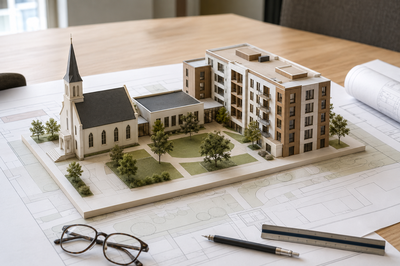
Virginia's 2026 General Assembly enacted companion bills HB 1279 and SB 388 (2026 Acts of Assembly, cc. 1096 and 1009), the Faith in Housing Act, adding § 15.2-2288.9 to the Code of Virginia. Localities must permit qualifying mixed-use or residential projects by right on land owned by property tax-exempt religious organizations and certain 501(c)(3) nonprofits, without rezoning, special use permit, or other discretionary approval. The section takes effect January 1, 2027 and expires January 1, 2031.
Because the section was enacted through two companion bills and codified as a single reconciled text, work from the codified section rather than either enrolled bill. Several provisions differ, and the differences are material.
Two Eligibility Screens
Tax-exempt status, not merely 501(c)(3). A "religious organization" is defined by reference to § 58.1-3617. A "501(c)(3) property tax-exempt nonprofit organization" must be exempt under § 501(c)(3) and hold real property tax exemption under § 58.1-3609. Federal recognition is common; the Virginia property tax exemption is considerably less so. Confirm status on the specific parcel with the commissioner of the revenue before anything else.
Five years of continuous ownership prior to the development application. Transfers among affiliates, reorganizations, congregational mergers, and name changes all complicate the record. This condition also constrains deal structure: conveying title to a development partner restarts the clock and defeats eligibility. Ground lease and joint venture structures preserving the organization's fee ownership should be evaluated before a partner is selected.
What the Statute Requires
Subsections A and B require localities to permit qualifying projects by right notwithstanding the use, height, or density otherwise allowed, and bar any special exception, special use permit, conditional use permit, or other discretionary approval as a condition of approving a plat, site plan, or plan of development. Review proceeds under §§ 15.2-2258 through 15.2-2261, and § 15.2-2286(A)(17) authorizes administrative approval.
Subsection J supplies comprehensive plan conformity: a project built pursuant to the section is deemed substantially in accord with the host locality's plan. One drafting note worth raising in the pre-application conference is that subsection J uses completion-oriented language for a question that arises at application. The better reading is that conformity attaches throughout, but do not assume the locality shares it.
What the statute does not remove is the engineering. Site plan and subdivision review, stormwater, wetlands permitting, VDOT access, and Health Department requirements all continue to apply, and subsection C(5) makes compliance an express condition of by-right treatment.
Minimum Standards Under Subsection D
- Height of 45 feet, or the tallest existing building within 500 feet, whichever is greater, excluding any building granted additional height by special exception. For property in a historic district designated as of January 1, 2026, height is controlled by the historic district regulations instead.
- Density of 20 units per acre, or the most intensive existing residential density within 500 feet, whichever is greater. A locality may by ordinance set higher minimum densities in a revitalization area, transit area, or area within a small area plan or sector plan, which is meaningful upside across Northern Virginia.
- Setbacks of 10 feet, or the smallest setback allowed for any existing property within 500 feet, whichever is less.
- Use mix of at least 70 percent residential gross floor area, with up to 30 percent in publicly accessible ground-floor nonresidential space (worship space, child day centers, health clinics, coffee shops, and uses ancillary to the organization's mission). Note the ground-floor and public-access qualifiers.
- Parking capped at one space per residential unit and one space per 300 square feet of nonresidential, or the fewest required locally, whichever is less. No additional requirements may be imposed on floor area ratio, minimum unit size, or minimum lot size.
Conditions and Exclusions
At least 60 percent of units must be affordable, at or below 80 percent of area median income for rentals and up to 120 percent for for-sale units, recorded and preserved for 30 years. Housing must be open to the general public and comply with the Virginia Fair Housing Law, so occupancy cannot be limited to members or congregants. All completed housing is subject to local real property taxation; the statute states this flatly and contains no exemption proviso, so model the full burden.
The utility condition is broader than commonly assumed and favorable to applicants: the property must be served by, or within an area planned for, public water and sewer. There is no distance test and no requirement of existing service at the property line. Satisfying the condition is not the same as having capacity, however, and connection points, available capacity, and extension obligations remain engineering and cost questions.
Subsection E excludes property zoned for or adjacent to land zoned industrial, and the adjacency prong is the trap: check every abutting parcel. Subsection H excludes parcels within an Air Installation Compatible Use Zones footprint in a locality with a master jet base, which as a practical matter is a Hampton Roads provision. Subsection H also preserves local authority under §§ 10.1-2206.1 and 15.2-2306 to protect historic and archaeological resources, so design review exposure is not eliminated.
Two Deadlines Before the Sunset
Subsection G permits a locality to adopt, prior to January 1, 2027, an ordinance for housing on qualifying property that substantially complies with the section, and to amend it afterward. The statute does not define substantial compliance, and a local ordinance narrowing the entitlement would be vulnerable on that ground. Monitor zoning ordinance work programs and Board and Council dockets where you hold land, and participate in drafting. A comment period is a far better forum for resolving an ambiguity than a site plan appeal three years later.
Transition rules: subsection F exempts existing permits approved before January 1, 2027, and subsection I exempts rezoning, special exception, and special use permit applications submitted before July 1, 2026. An organization with a legislative application on file should evaluate whether proceeding by right after the effective date produces a better outcome.
The sunset itself is unresolved. The section expires January 1, 2031 and says nothing about projects approved but not completed. Vested rights under § 15.2-2307 require a significant affirmative governmental act, good faith reliance, and substantial expenditure, which an approved plat or site plan is far more likely to satisfy than a filed application. Treat this as a structuring problem: build schedule cushion, secure the qualifying approval early, document reliance contemporaneously, and address sunset risk expressly in loan documents, joint ventures, and ground leases.
What to Do in 2026
The effective date is January 1, 2027, but the preparatory work belongs to 2026. Confirm the two eligibility screens and assemble the supporting documentation. Check the zoning of the subject and every abutting parcel, confirm water and sewer status and separately confirm capacity, and identify any historic district overlay established as of January 1, 2026.
Then prepare the dimensional exhibits. Three statutory standards are measured within 500 feet of the property line: the tallest existing building (and whether its height came from a special exception), the most intensive existing residential density, and the smallest existing setback. A survey-based exhibit establishing those figures converts contestable assertions into documented ones and shortens review. Settle the ownership structure, plan how 30-year affordability will be administered, and schedule a pre-application conference while the locality's approach is still forming.
Please contact Andrew Gregg at 703.525.4000 or agregg@beankinney.com with questions about whether your property may qualify under § 15.2-2288.9, or how to structure a development project under the Faith in Housing Act.
This article is for informational purposes only and does not contain or convey legal advice. Consult a lawyer. Any views or opinions expressed herein are those of the author and are not necessarily the views of any client.