Construction
Northern Virginia Development Fees Surge Towards Full Cost Recovery
July 9, 2025

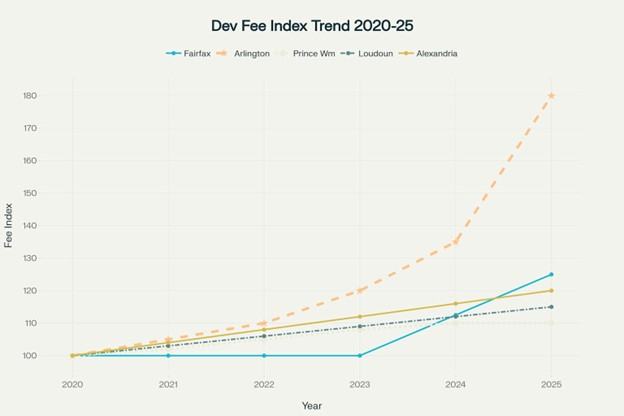
Northern Virginia jurisdictions are implementing significant fee increases ranging from 5% to 25% during 2024-2025, with most localities targeting 100% cost recovery for development services. This fundamental shift from taxpayer-subsidized services to developer-funded operations represents the most substantial fee restructuring in nearly a decade, driven by mounting budget pressures and aging technology infrastructure across the region.
The research reveals three critical trends reshaping development economics: technology surcharges now reach 10% in multiple jurisdictions, two-year phased implementations have become the standard approach to minimize industry shock, and smaller municipalities are adopting sophisticated cost recovery frameworks previously limited to large counties. These changes will significantly impact project economics, with some jurisdictions facing development fund deficits exceeding $3.8 million annually.
Fairfax County Leads with Comprehensive Two-Year Restructuring
Fairfax County approved its first major fee update since 2015 on April 16, 2024, implementing a 25% building fee increaseand 10% site-related fee increase over two years. The phased approach divides increases equally: 12.5% for building fees and 5% for site fees in July 2024, with identical increases in July 2025. The county’s technology surcharge escalates dramatically from 4% to 10% by 2025, funding critical PLUS system enhancements.
The Board of Supervisors explicitly directed Land Development Services to achieve approximately 100% cost recovery, marking a significant policy shift. A new 1% code academy surcharge in 2024 (increasing to 2% in 2025) addresses staff training needs. Applications submitted before each implementation date retain previous fee schedules, providing some relief for projects already in planning. The county cites rising personnel costs, inflation, and operational expenses as primary drivers for the restructuring.
Arlington County Confronts $3.8 Million Development Fund Crisis
Arlington faces the region’s most severe financial challenge with its Community Planning, Housing and Development department operating at a $3.8 million annual deficit – expenses of $29.1 million versus revenue of $25.3 million in FY 2025. County Manager Mark Schwartz advocates shifting from taxpayer subsidy to full cost recovery from developers, proposing substantial fee increases for FY 2026.
The crisis has created a paradox: despite planned revenue increases, the county is implementing staff reductions that will further delay permit processing. Current delays have doubled, with same-day permits now taking 1-3 weeks and standard 2-3 month permits requiring twice the normal time. The Arlington Chamber of Commerce and NAIOP have warned that excessive fee increases combined with reduced service levels may undermine the county’s business-friendly objectives and affordable housing goals.
Prince William County Maintains Moderate Approach
Prince William implemented more modest increases effective July 1, 2024: 5% for land development feesand 2% for building development fees. The county approved an additional 5% land development increase for FY 2026 but held building fees flat, demonstrating a measured approach to cost recovery. With a focus on supporting data center development as a targeted industry, the county balances revenue needs with economic development priorities.
The county’s fee structure supports comprehensive services including rezoning applications, site plans, geotechnical studies, and Virginia Uniform Statewide Building Code enforcement. Payment flexibility includes acceptance of credit cards with a 2.3% service fee effective June 2025. The FY 2026 budget adoption on April 22, 2025, allocated $1.99 billion with continued investment in digital services through the ePortal system.
Loudoun County Leverages Data Center Revenue While Pursuing Cost Recovery
Loudoun’s unique position as the nation’s data center capital creates distinct dynamics. Data centers generate approximately 50% of property tax revenue, with assessments increasing 25% in 2024 alone, adding $16 billion in value. This revenue has enabled the county to reduce its real property tax rate from $1.285 in 2008 to $0.805 in 2024, while still pursuing 100% cost recovery for development services.
Cities Pursue Independent Strategies with Distinct Approaches
Alexandria implemented new fees effective July 1, 2024, with processing fees added January 13, 2025. The city requires 35% plan review deposits for all projects, with large commercial projects over 15,000 square feet paying 19.5 cents per square foot upfront. The APEX electronic system handles all permitting, with historic district projects facing additional Board of Architectural Review requirements. The city maintains a $926.4 million operating budget with ongoing analysis of fee waivers for affordable housing projects.
Falls Church demonstrates how smaller jurisdictions can maintain efficiency with simplified fee structures. The city charges a $67.10 minimum permit fee with straightforward percentage-based surcharges: 10% technology enhancement, 10% administrative support, and 2% state levy. Credit card payments incur an additional 2.95% fee. Despite its 2.2 square mile size, Falls Church manages significant mixed-use development through special exception entitlements, coordinating with regional partners including WMATA and Virginia Tech.
Towns Implement Coordinated Approaches with Counties
Vienna operates a dual-permit system requiring both Town zoning review and Fairfax County building permits. The town updated its zoning code effective January 1, 2024, streamlining processes while maintaining local control. Using IDT Plans and GeoCivix platforms separate from county systems, Vienna adds town-specific fees atop Fairfax County charges.
Leesburg demonstrates sophisticated planning with Capital Intensity Factors (CIF) adopted in May 2024. These per-household cost estimates for capital facilities provide systematic cost recovery through proffer negotiations during rezoning. The town requires zoning permits before Loudoun County building permits, using the eTRAKiT portal for electronic processing. Annual CIF indexing using Engineering News Record’s Construction Cost Index ensures fees track construction costs. A comprehensive zoning ordinance rewrite underway through May 2025 may bring additional changes.
Technology Surcharges Emerge as Significant Revenue Stream
Technology fees have become a major component of development costs across the region. Fairfax County’s escalation from 4% to 10% represents the most aggressive increase, while Falls Church maintains a steady 10% technology enhancement fee. These surcharges fund critical infrastructure improvements including online permitting systems, electronic plan review capabilities, and customer service enhancements.
Arlington’s Permit Arlington system illustrates implementation challenges, with a two-year migration still experiencing significant issues. In contrast, Loudoun’s LandMARC and Leesburg’s eTRAKiT demonstrate successful deployments. Investment in digital infrastructure has become essential for maintaining competitiveness and service quality.
Comparative Analysis Reveals Regional Disparities
Fee structures vary significantly across jurisdictions. Counties generally implement broader, more complex fee schedules while cities and towns maintain streamlined approaches. The largest disparities appear in technology surcharges (ranging from none to 10%) and cost recovery targets (from partial to 100%).
Timing of increases also varies considerably. While Fairfax and Prince William implemented changes in July 2024, Arlington delays until July 2025. Some jurisdictions like Loudoun show little evidence of recent updates, potentially indicating forthcoming significant adjustments. Mixed-use and data center projects face the most complex fee structures, often triggering multiple review processes and department fees.
Municipal Rationales Reflect Evolving Fiscal Realities
Jurisdictions consistently cite similar justifications for fee increases: rising personnel costs, inflation, technology infrastructure needs, and service level maintenance. The shift from general fund subsidies to user-fee funding represents a fundamental policy change, with elected officials increasingly viewing development review as a service that should pay for itself rather than burden taxpayers. Cost recovery goals range from maintaining competitiveness to achieving full financial sustainability.
Conclusion
Northern Virginia’s development fee landscape has entered a period of dramatic transformation, with 2024-2025 marking the most significant restructuring in a decade. The universal movement toward 100% cost recovery, coupled with substantial technology investments and phased implementation strategies, signals a permanent shift in how jurisdictions fund development services. Developers must now budget for total fee increases ranging from 7% to 35% over two years, with technology surcharges adding up to 10% additional costs.
The research reveals three critical insights for stakeholders. First, early application submission before implementation dates provides the only reliable protection against fee increases, as most jurisdictions grandfather existing applications. Second, jurisdictions pursuing aggressive increases without corresponding service improvements risk damaging their competitive position. Finally, the success of phased implementations in minimizing industry disruption while achieving revenue goals suggests this approach will become the regional standard. As jurisdictions balance fiscal sustainability with economic development objectives, the next 18 months will determine whether Northern Virginia maintains its attractiveness for development investment or prices itself out of regional competition.
For strategic guidance on navigating Northern Virginia’s transformed development fee environment and maximizing your project’s competitive positioning, please contact Andrew Gregg at (703) 284-7254 or agregg@beankinney.com.
This article is for informational purposes only and does not contain or convey legal advice. Consult a lawyer. Any views or opinions expressed herein are those of the authors and are not necessarily the views of any client.